
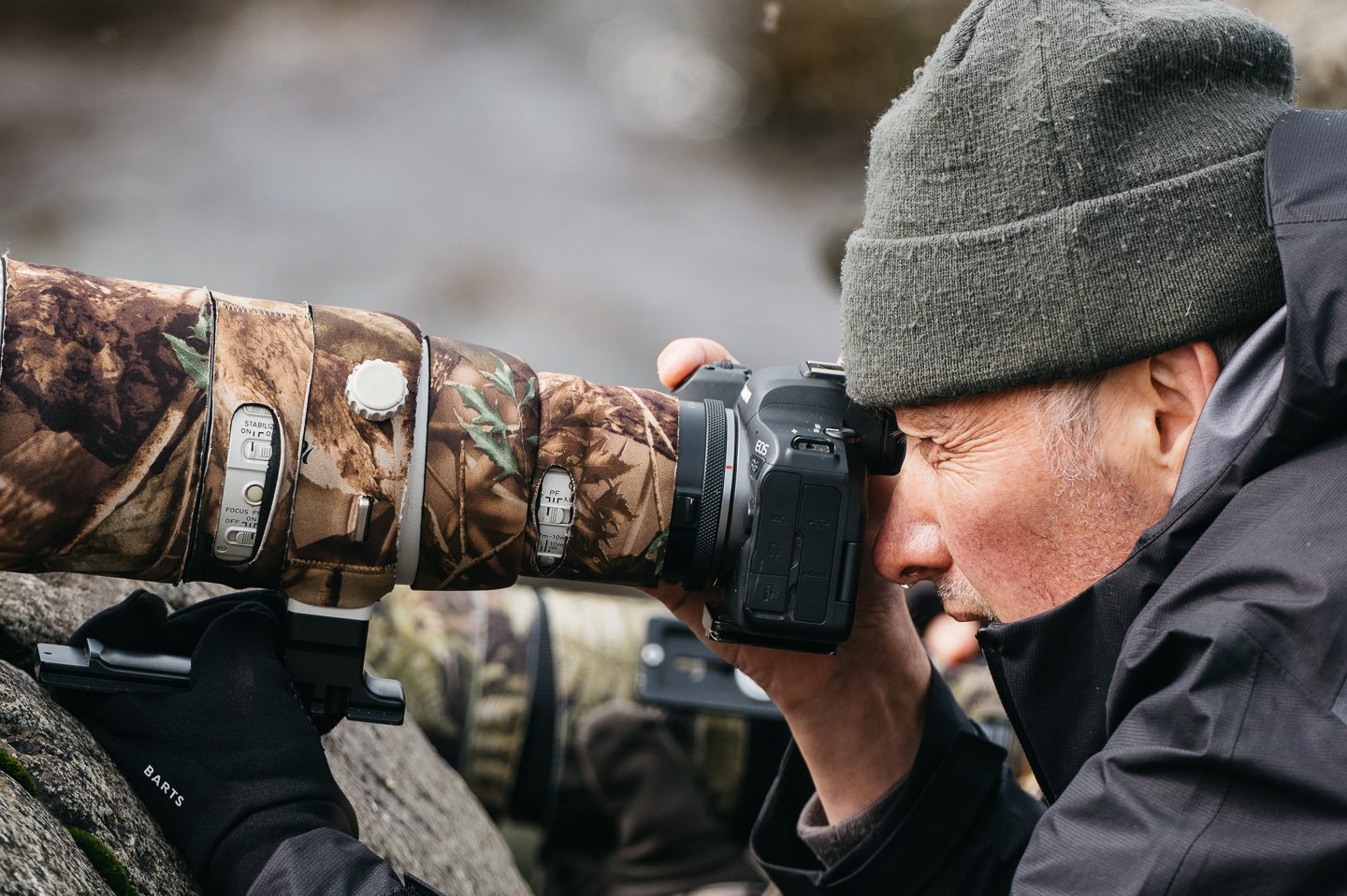
How to photograph wildlife without disturbing animalsWe are fervent defenders of wildlife, but also passionate about nature and curious about the world around us. However, this does not prevent us from objectively analysing our behaviour in the wild, and that of wildlife photographers in general. The primary goal is to answer the question: how can we take wildlife photographs without disturbing the animals?
We have heard many people say that it is possible to practice wildlife photography without disturbing the animals or having any impact on wildlife. We believe that this is not true. We always see an impact, in one way or another.
We can always be very careful about the direction of the wind or the noise we make, but we forget that these precautions only concern the animal in front of us. By remaining discreet in front of one individual, we may have disturbed ten others behind us without even realising it.
Our philosophy is therefore to recognise that our presence may disturb animals and to do our best to limit this disturbance. Our primary goal is, above all, to avoid endangering animals by our presence. Next, we try to avoid stressful situations. Finally, depending on the situation, we adapt the appropriate level of discretion. Because yes, hiding is not always the best option. For example, in areas where hunting is prohibited, and animals are not very fearful, hiding can be more disturbing to animals than staying visible and identifiable. This is the case during our photography tour in Iceland, where photographers are asked not to hide and to remain visible and at a safe distance, as the Arctic foxes there are used to humans, provided they respect their safe distance and their path.
The different techniques of wildlife photography
If you are new to wildlife photography, you should know that there are several techniques and schools of thought, each with its own advantages and disadvantages. Generally, photographers favour one or the other depending on their objectives. It must also be said that if you feel comfortable with a particular technique, you tend to continue in that direction.
But before choosing a technique, our advice is to try them all. The goal is to understand the advantages and disadvantages of each one, on the one hand, and to enter the world of wildlife photography with the necessary knowledge and experience, on the other.
The technique of the blind (hide)
The technique of the blinbde consists of concealing oneself behind a solid or flexible shelter (a camouflage net, for example), or using vegetation and other elements of the landscape. This shelter is constructed after prospecting to determine the best location for observation and wildlife photography. It must therefore meet certain objectives, such as proximity to a place where animals regularly pass or are present, good orientation in relation to the wind, etc.
The hide technique has the advantage of being the most discreet. You literally disappear into the environment and, once in the hide, the animals can no longer see any movement and, ideally, cannot hear any noise.
On the other hand, once in the hide, you no longer have freedom of movement. In other words, the hide allows no flexibility. This technique is not suitable for people who need to move around or for situations that are too unpredictable.
The hide also offers the advantage of good waiting conditions: you can drink coffee, use a blanket in cold weather, eat… It’s like a little home you can build for yourself.
The approach technique
The approach technique is certainly the most delicate and the one that can cause the most disturbance, especially if you are new to wildlife photography. At Wildlife Photo Travel, we advise beginners not to use this technique, and instead to favour the hide after a short period of scouting with binoculars.
The approach technique involves spotting animals during a reconnaissance and gradually approaching them until you reach a good position to take pictures. Unlike the hide technique, the approach technique offers more flexibility. It allows you to adapt to the subject’s movements, but also to related events.
We do not recommend the approach technique to novice wildlife photographers for one simple reason: it requires in-depth knowledge of the species, their senses and their psychology, as well as knowledge of the terrain and approach techniques. In other words, if you want to approach a deer, you have to think like a deer and see like a deer. Otherwise, the failure rate, and therefore the disturbance rate, will be far too high.
The technique of wildlife wandering
Wandering is not really a technique, but more a state of mind. It simply consists of strolling around and seizing opportunities as they arise. As you might expect, this technique is the one that yields the fewest results and causes the most disturbance. However, by repeating the same route, the same walk, you end up observing the same animals in the same places, which gradually increases your success rate. The walk then turns into a long-term search. You can sometimes decide to combine Wandering with other techniques, such as hide photography.
Wandering is, however, practised by many wildlife photographers who want to keep things light. It requires no prospecting or long waits in the cold (or heat). All you need is lightweight, portable equipment that is suitable for use on walks or hikes.
A few tips for minimising disturbance when photographing wildlife
1. Research the species you want to photograph
Knowledge and learning are our first pieces of advice. As a general rule, the more you know about animals, the less you disturb them. Conversely, how can you limit disturbance to a species you know nothing about?
Some essential information to know includes:
- Physical characteristics (vision, hearing, sense of smell, etc.)
- Diet
- Breeding season
- Birthing season
- Predators (including humans)
- Stress factors
We recommend finding monographs on the species you wish to photograph. These books usually contain all the information you need.
2. Wind direction
Although you probably already know this, it is always useful to remember that when photographing animals with a keen sense of smell, you must constantly pay attention to the direction of the wind. In other words, you should always have the wind at your back. As soon as your subjects can smell you, you can consider the session over. In this case, it is best to retreat discreetly to minimise stress.
3. Wear clothes that do not make noise.
Be careful with synthetic clothing such as ski or rainwear. These garments can make a lot of noise when you move, alerting animals. Instead, opt for soft wool and fleece clothing if it is cold, or cotton if it is warm.
Of course, sometimes the choice is limited. For example, rainwear inevitably makes noise. In this case, you can only do your best by choosing the least noisy waterproof clothing and adapting your behaviour (limiting your movements, moving more slowly, etc.).
4. Learning to move around in the wilderness
It may seem obvious, but not everyone knows this. A wildlife photographer must constantly improve their movement and terrain choices. Walking on dead leaves makes much more noise than walking on soil or grass. Similarly, walking on snow makes less noise than walking on frost.
To improve your movements, especially when you are new to wildlife photography, you must constantly listen to gauge the noise of your footsteps and movements. It is by paying attention that you become aware of the noise you make. This is how you can improve.
The choice of footwear is also important, as some shoes make more noise than others. Generally, the heavier the shoes (boots, for example), the more noise you make. The ideal solution is therefore to opt for lightweight footwear, within the limits of weather constraints.
5. Study the field
If you lack knowledge of the terrain, there is a good chance you will miss some approaches or blinds. Before setting off, it is always useful to study a map and find a high point from which you can observe the landscape. This information will help you move around more effectively and avoid being taken by surprise.
6. Adapting behavior to nature reserves
Hunting is often prohibited in nature reserves. As a result, animals gradually lose their fear of humans. But that doesn’t mean they aren’t subject to stress. Adapting your behavior to animals living in nature reserves means understanding both their safe distance and their habits around humans, as well as whether or not it is necessary to wear camouflage clothing.
As mentioned above, animals that are used to being around humans without any predatory relationship are less fearful. Often, it is not necessary to wear camouflage clothing. However, ask yourself questions such as where these animals go to feed themselves and, above all, their young. Even if they seem unafraid at first glance, it is important never to come between animals, their food, and their offspring. The consequences of this type of disturbance can be dramatic, even leading to the death of young animals that do not receive enough food.
7. Limit the amount of time spent in front of an individual
Whether the animal you are photographing is fearful or not, you should limit the amount of time you spend in its vicinity and avoid any behavior that could be perceived as harassment. Staying close to an animal for hours on end puts it at too great a risk.
When the animal is aware of your presence, it is best to limit your time to a few minutes. If, on the other hand, the animal is unaware of your presence (for example, when using a blind), then you can stay longer, but keep in mind that other animals have probably already spotted you.
8. All interaction is prohibited!
And yes, we still need to say it today: it is strongly discouraged to interact with wild animals in any way. This includes talking to them, gesturing at them, or feeding them.
Interacting with a wild animal distracts it from its goals of feeding, safety, and reproduction. You would be surprised at the damage that can be caused by behaviors that may seem harmless at first glance. We therefore advise you to keep your distance and turn away from animals that try to interact with you.
9. Accepting the waiting, weather conditions, and failures
During our photography workshops, we try to make photographers aware of the importance of accepting what nature has to offer, or not! Wildlife photography is an activity that involves a lot of disappointment, and you have to learn to manage your frustration.
Managing your expectations and frustration is important, both to move forward after a setback and to avoid changing your behavior and potentially harming wildlife.
It’s not always easy to accept failure and take the necessary step back. We advise you to prepare yourself psychologically before going out into the field. This preparation involves limiting your expectations and accepting in advance that you may spend hours or days without encountering any animals. You also need to find other interests. Nature is rich in flora, insects, and elements, inviting exploration and contemplation. You don’t necessarily need to have a spectacular encounter to appreciate nature.
10. Avoid outings in large groups.
It goes without saying that the more people there are, the greater the risk of disturbing the local wildlife. If you go on group outings or take part in wildlife photography workshops, avoid having too many people. The ideal solution is to spread out over a large area to limit the impact.
Imagine a fox seeing 15 people arrive near its den. The result is that it will immediately move its family, which can have dramatic consequences.
In the wilderness, opt for groups of 2 to 4 people maximum, applying other precautions for wildlife photography to limit disturbance.
Conclusion
While taking wildlife photographs without disturbing the animals is a myth, we still believe it is essential to take the time and energy to limit this disturbance. We must put animal welfare above all else. And if we miss a shot because we took care not to be spotted, then that’s a good thing.
This means spending more time learning than taking pictures, but for us, that’s the price we’re willing to pay.
We are witnesses, and we must remain so. But above all, let’s protect the nature that is so dear to us.
We are fervent defenders of wildlife, but also passionate about nature and curious about the world around us. However, this does not prevent us from objectively analysing our behaviour in the wild, and that of wildlife photographers in general. The primary goal is to answer the question: how can we take wildlife photographs without disturbing the animals?
We have heard many people say that it is possible to practice wildlife photography without disturbing the animals or having any impact on wildlife. We believe that this is not true. We always see an impact, in one way or another.
We can always be very careful about the direction of the wind or the noise we make, but we forget that these precautions only concern the animal in front of us. By remaining discreet in front of one individual, we may have disturbed ten others behind us without even realising it.
Our philosophy is therefore to recognise that our presence may disturb animals and to do our best to limit this disturbance. Our primary goal is, above all, to avoid endangering animals by our presence. Next, we try to avoid stressful situations. Finally, depending on the situation, we adapt the appropriate level of discretion. Because yes, hiding is not always the best option. For example, in areas where hunting is prohibited, and animals are not very fearful, hiding can be more disturbing to animals than staying visible and identifiable. This is the case during our photography tour in Iceland, where photographers are asked not to hide and to remain visible and at a safe distance, as the Arctic foxes there are used to humans, provided they respect their safe distance and their path.
The different techniques of wildlife photography
If you are new to wildlife photography, you should know that there are several techniques and schools of thought, each with its own advantages and disadvantages. Generally, photographers favour one or the other depending on their objectives. It must also be said that if you feel comfortable with a particular technique, you tend to continue in that direction.
But before choosing a technique, our advice is to try them all. The goal is to understand the advantages and disadvantages of each one, on the one hand, and to enter the world of wildlife photography with the necessary knowledge and experience, on the other.
The technique of the blind (hide)
The technique of the blinbde consists of concealing oneself behind a solid or flexible shelter (a camouflage net, for example), or using vegetation and other elements of the landscape. This shelter is constructed after prospecting to determine the best location for observation and wildlife photography. It must therefore meet certain objectives, such as proximity to a place where animals regularly pass or are present, good orientation in relation to the wind, etc.
The hide technique has the advantage of being the most discreet. You literally disappear into the environment and, once in the hide, the animals can no longer see any movement and, ideally, cannot hear any noise.
On the other hand, once in the hide, you no longer have freedom of movement. In other words, the hide allows no flexibility. This technique is not suitable for people who need to move around or for situations that are too unpredictable.
The hide also offers the advantage of good waiting conditions: you can drink coffee, use a blanket in cold weather, eat… It’s like a little home you can build for yourself.
The approach technique
The approach technique is certainly the most delicate and the one that can cause the most disturbance, especially if you are new to wildlife photography. At Wildlife Photo Travel, we advise beginners not to use this technique, and instead to favour the hide after a short period of scouting with binoculars.
The approach technique involves spotting animals during a reconnaissance and gradually approaching them until you reach a good position to take pictures. Unlike the hide technique, the approach technique offers more flexibility. It allows you to adapt to the subject’s movements, but also to related events.
We do not recommend the approach technique to novice wildlife photographers for one simple reason: it requires in-depth knowledge of the species, their senses and their psychology, as well as knowledge of the terrain and approach techniques. In other words, if you want to approach a deer, you have to think like a deer and see like a deer. Otherwise, the failure rate, and therefore the disturbance rate, will be far too high.
The technique of wildlife wandering
Wandering is not really a technique, but more a state of mind. It simply consists of strolling around and seizing opportunities as they arise. As you might expect, this technique is the one that yields the fewest results and causes the most disturbance. However, by repeating the same route, the same walk, you end up observing the same animals in the same places, which gradually increases your success rate. The walk then turns into a long-term search. You can sometimes decide to combine Wandering with other techniques, such as hide photography.
Wandering is, however, practised by many wildlife photographers who want to keep things light. It requires no prospecting or long waits in the cold (or heat). All you need is lightweight, portable equipment that is suitable for use on walks or hikes.
A few tips for minimising disturbance when photographing wildlife
1. Research the species you want to photograph
Knowledge and learning are our first pieces of advice. As a general rule, the more you know about animals, the less you disturb them. Conversely, how can you limit disturbance to a species you know nothing about?
Some essential information to know includes:
- Physical characteristics (vision, hearing, sense of smell, etc.)
- Diet
- Breeding season
- Birthing season
- Predators (including humans)
- Stress factors
We recommend finding monographs on the species you wish to photograph. These books usually contain all the information you need.
2. Wind direction
Although you probably already know this, it is always useful to remember that when photographing animals with a keen sense of smell, you must constantly pay attention to the direction of the wind. In other words, you should always have the wind at your back. As soon as your subjects can smell you, you can consider the session over. In this case, it is best to retreat discreetly to minimise stress.
3. Wear clothes that do not make noise.
Be careful with synthetic clothing such as ski or rainwear. These garments can make a lot of noise when you move, alerting animals. Instead, opt for soft wool and fleece clothing if it is cold, or cotton if it is warm.
Of course, sometimes the choice is limited. For example, rainwear inevitably makes noise. In this case, you can only do your best by choosing the least noisy waterproof clothing and adapting your behaviour (limiting your movements, moving more slowly, etc.).
4. Learning to move around in the wilderness
It may seem obvious, but not everyone knows this. A wildlife photographer must constantly improve their movement and terrain choices. Walking on dead leaves makes much more noise than walking on soil or grass. Similarly, walking on snow makes less noise than walking on frost.
To improve your movements, especially when you are new to wildlife photography, you must constantly listen to gauge the noise of your footsteps and movements. It is by paying attention that you become aware of the noise you make. This is how you can improve.
The choice of footwear is also important, as some shoes make more noise than others. Generally, the heavier the shoes (boots, for example), the more noise you make. The ideal solution is therefore to opt for lightweight footwear, within the limits of weather constraints.
5. Study the field
If you lack knowledge of the terrain, there is a good chance you will miss some approaches or blinds. Before setting off, it is always useful to study a map and find a high point from which you can observe the landscape. This information will help you move around more effectively and avoid being taken by surprise.
6. Adapting behavior to nature reserves
Hunting is often prohibited in nature reserves. As a result, animals gradually lose their fear of humans. But that doesn’t mean they aren’t subject to stress. Adapting your behavior to animals living in nature reserves means understanding both their safe distance and their habits around humans, as well as whether or not it is necessary to wear camouflage clothing.
As mentioned above, animals that are used to being around humans without any predatory relationship are less fearful. Often, it is not necessary to wear camouflage clothing. However, ask yourself questions such as where these animals go to feed themselves and, above all, their young. Even if they seem unafraid at first glance, it is important never to come between animals, their food, and their offspring. The consequences of this type of disturbance can be dramatic, even leading to the death of young animals that do not receive enough food.
7. Limit the amount of time spent in front of an individual
Whether the animal you are photographing is fearful or not, you should limit the amount of time you spend in its vicinity and avoid any behavior that could be perceived as harassment. Staying close to an animal for hours on end puts it at too great a risk.
When the animal is aware of your presence, it is best to limit your time to a few minutes. If, on the other hand, the animal is unaware of your presence (for example, when using a blind), then you can stay longer, but keep in mind that other animals have probably already spotted you.
8. All interaction is prohibited!
And yes, we still need to say it today: it is strongly discouraged to interact with wild animals in any way. This includes talking to them, gesturing at them, or feeding them.
Interacting with a wild animal distracts it from its goals of feeding, safety, and reproduction. You would be surprised at the damage that can be caused by behaviors that may seem harmless at first glance. We therefore advise you to keep your distance and turn away from animals that try to interact with you.
9. Accepting the waiting, weather conditions, and failures
During our photography workshops, we try to make photographers aware of the importance of accepting what nature has to offer, or not! Wildlife photography is an activity that involves a lot of disappointment, and you have to learn to manage your frustration.
Managing your expectations and frustration is important, both to move forward after a setback and to avoid changing your behavior and potentially harming wildlife.
It’s not always easy to accept failure and take the necessary step back. We advise you to prepare yourself psychologically before going out into the field. This preparation involves limiting your expectations and accepting in advance that you may spend hours or days without encountering any animals. You also need to find other interests. Nature is rich in flora, insects, and elements, inviting exploration and contemplation. You don’t necessarily need to have a spectacular encounter to appreciate nature.
10. Avoid outings in large groups.
It goes without saying that the more people there are, the greater the risk of disturbing the local wildlife. If you go on group outings or take part in wildlife photography workshops, avoid having too many people. The ideal solution is to spread out over a large area to limit the impact.
Imagine a fox seeing 15 people arrive near its den. The result is that it will immediately move its family, which can have dramatic consequences.
In the wilderness, opt for groups of 2 to 4 people maximum, applying other precautions for wildlife photography to limit disturbance.
Conclusion
While taking wildlife photographs without disturbing the animals is a myth, we still believe it is essential to take the time and energy to limit this disturbance. We must put animal welfare above all else. And if we miss a shot because we took care not to be spotted, then that’s a good thing.
This means spending more time learning than taking pictures, but for us, that’s the price we’re willing to pay.
We are witnesses, and we must remain so. But above all, let’s protect the nature that is so dear to us.
Sorry, the comment form is closed at this time.